Goats for Weed Control
Targeted grazing on the NSW Mid North Coast - the woody weeds go, the pasture stays, and nothing goes in the water.
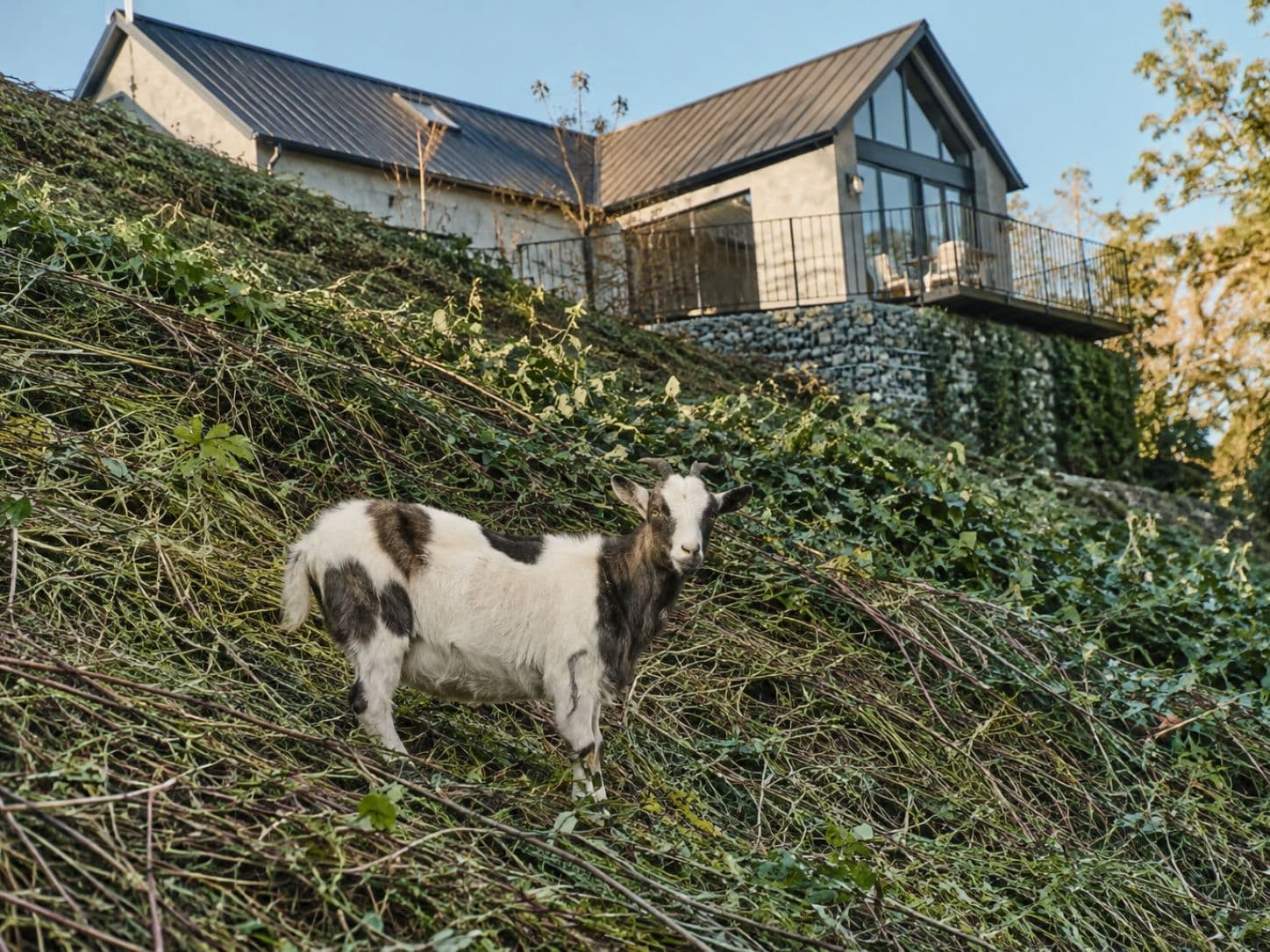
- Steep ground
- Near waterways
- No chemicals
- No machinery
- Fire breaks
What is it?
Using goats for weed control involves putting a herd of goats into a relatively tight area and letting them eat through the vegetation.
We do this by fencing them into the target area with portable electric fencing, and moving that fencing as the goats progress through the area.
Free on-site look before you commit.
Why goats and not something else
Most other livestock are grazers, while goats are browsers. This means they prefer to eat the leaves, vines and fiberous material, instead of focusing on the grass.
They're also more resistant to certain types of weeds that other livestock can't or won't eat, and they can handle much steeper, rougher terrain.
All this means goats are great for weeds, and leave the grass alone.
What they’ll clear
On the Mid North Coast the usual list is lantana, blackberry, privet, groundsel bush, camphor laurel regrowth, bitou bush on the coast, and the tall rank grasses that come back after every wet season. They’ll also take wattle and tobacco bush regrowth, cobbler’s peg, fleabane and most of the broadleaf weeds that turn up in tired pasture.
Lantana deserves its own page, because it’s the one we get called about most and it needs handling carefully - how to actually get rid of lantana.
What they won’t, and what’s dangerous
What they don't like- madeira vine, cat’s claw creeper, prickly pear, stinging nettle. If one of these is the main problem on your block, goats aren’t your answer and we’ll say so rather than take the booking.
What we manage carefully- lantana, fireweed, Paterson’s curse, phalaris and a few others carry a real toxin load. Goats handle them far better than cattle, but we have to minimise their exposure and always ensure they have ample access to other food.
Plants that have to go or be fenced off - green cestrum, oleander, azalea and rhododendron, yew, and mother of millions. These can kill the goats, sometimes from a single feed.
Where goats are best
Not everywhere - if you have flat open ground, covered in grass, then a slasher is likely a better option.
- Steep, rocky or uneven ground - where there is serious risks (or it's completely inaccessible) to people or machinery.
- Waterways - where herbicides could impact the waterway, or machinery could destroy the bank.
- Around houses, livestock, kids and pets- where there’s no withholding period to think about afterwards.
- Regenerating bush - where you want the weed gone without taking out the natives coming through underneath.
- Fire breaks and asset protection zones - where you need to take care of fuel loads without damaging the surrounding habitat.
What you need on site
- Water - access to a trough, or a tap we can run water from to our trough. We can also cart water with an IBC if needed.
- Vehicle access - for a ute and trailer, and access at any hour for welfare checks.
- Fencing - usually this is our portable electric fencing. Existing stock fencing is a bonus, but not a requirement.
- Dogs contained - while your dog may be friendly, it's not worth the risk to our goats or your dogs.
Where we work
We operate out of Port Macquarie and cover Port Macquarie, Wauchope, Kempsey, the Camden Haven, Taree and Forster.
Questions about goat weed management
How does using goats for weed control work?
We fence a section of your block with temporary electric fencing, put a mob of goats in it, and move the fence as they clear. They browse the woody weeds and tall growth from the ground to about two metres, then we shift them to the next cell. It's called targeted or prescribed grazing, and the fencing is what makes it targeted.
Why goats and not sheep or cattle?
Because goats are browsers rather than grazers. Around 60% of a goat's natural diet is browse - leaf, vine and woody shrub - against roughly 10 to 15% for a cow. Cattle and sheep walk past blackberry, thistle and nettle. That's also why goats tend to knock the weeds back and leave your pasture, rather than the other way round.
Will goats eat my pasture instead of the weeds?
Some, but it isn't what they're after. Goats prefer to eat taller, woodier plants than just grass. Eating grass is also how they get worm issues, so we try to keep them focused on the taller stuff for everyone's benefit.
Are there weeds goats won't eat?
Plenty. Some they simply don't like - madeira vine, cat's claw creeper, prickly pear. Others they avoid because they're toxic, and a few are dangerous enough that they have to be removed or fenced out before the herd arrives - green cestrum, oleander, and mother of millions among them. We check for all of it on the site inspection.
Is goat weed management a permanent fix?
Just like slashing, mulching, spraying, fire or manual removal, targeted grazing is not a one-shot-kill and often needs to be repeated, or combined with other methods and tactics. Grazing gives you strong suppression and it stops weeds seeding, but woody weeds rebound if you walk away afterwards. Goats work best as a repeated treatment, or as the heavy lifting in a plan that includes follow-up. We'd rather tell you that up front than sell you a one-visit miracle.
What does goat weed control cost?
It comes down to three things: the size of the area, how thick the growth is, and how far you are from Port Macquarie. Size and density determine how long the herd stays, and distance sets what the welfare checks cost us every one to three days. We quote per site after a free look.
Find out if goats suit your block
Tell us where you are and what you’re dealing with using the form below. We’ll come and look, and give you a straight answer - including when the answer is that you want a slasher, not a goat.
Tell us about your block
No obligation, no deposit.